
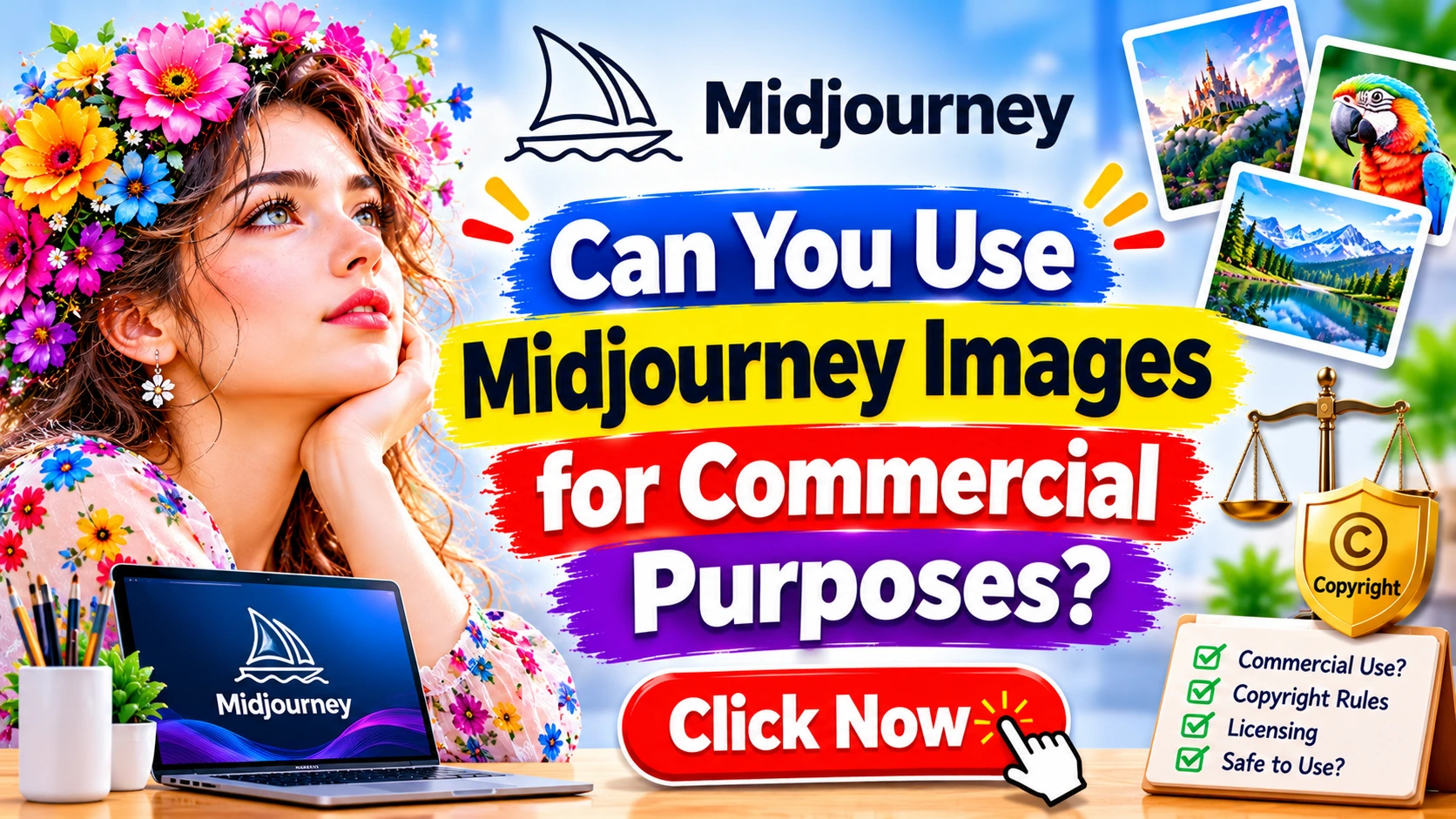
Can You Use Midjourney Images for Commercial Purposes? The Definitive Guide
The intersection of artificial intelligence and creativity has sparked a revolution. In the past, creating a high-quality, photorealistic image required either a professional photographer, a skilled graphic designer, or expensive stock photography licenses. Today, with tools like Midjourney, a simple text prompt can generate stunning visuals in seconds. However, this technological leap has brought with it a labyrinth of legal and ethical questions.
For entrepreneurs, bloggers, marketers, and business owners, the allure of AI-generated art is undeniable. It offers a way to cut costs, accelerate content production, and create unique branding assets. But before you hit “download” and slap a Midjourney image on your product packaging, a billboard, or your company website, you must understand the intricacies of Midjourney commercial use.
1. The AI Revolution: Why This Matters for Your Business 
We are witnessing a paradigm shift in how content is created. Generative AI has moved from the realm of science fiction into the daily workflow of digital agencies and small businesses. Midjourney, known for its artistic, high-fidelity output, is at the forefront of this shift.
However, using AI art for a school project is vastly different from using it to sell a product. When money changes hands, the stakes become significantly higher. You are no longer just a user; you are a commercial entity subject to copyright laws, terms of service, and potential litigation.
The question of whether you can use Midjourney images for commercial purposes is not just a technicality—it is a fundamental business decision that impacts your brand’s liability. If you use an image that infringes on someone else’s copyright or violates the platform’s terms, you could face takedown notices, loss of revenue, or even lawsuits.
In this comprehensive guide, we will dissect the terms of service, analyze current copyright law, and provide a step-by-step framework for using Midjourney safely and effectively in a commercial context.
2. The Core Question: Can You Use Midjourney Commercially? 
The Short Answer: Yes, generally speaking, you can use the images you create with Midjourney for commercial purposes, provided you are a paying subscriber. However, there are significant caveats regarding copyright ownership, exclusivity, and the content of the image itself.
The Long Answer: Midjourney operates on a subscription model. The rights granted to you depend entirely on your subscription tier. If you are on the free trial (which is often disabled) or a basic tier, your usage rights are restricted. For paid users, Midjourney grants you an “Asset License” to the images you generate.
However, the critical distinction lies in copyright. While Midjourney gives you a license to use the image, U.S. copyright law currently states that you cannot copyright an image generated entirely by AI. This means while you can sell a t-shirt with a Midjourney design, you cannot stop someone else from copying that design and selling it themselves, because you don’t “own” the copyright in the eyes of the law.
Let’s break down the specific mechanics of the Midjourney licensing model.
3. Deep Dive into Midjourney’s Terms of Service 
To understand your rights, you must look at Midjourney’s Terms of Service (ToS). As of recent updates, the key points regarding commercial use are:
- Ownership: Midjourney does not claim ownership of the images you create. They grant you a perpetual, worldwide, non-exclusive, sublicensable, no-charge, royalty-free, irrevocable copyright license to reproduce, prepare derivative works of, publicly display, publicly perform, sublicense, and distribute text and image prompts.
- Subscription Tiers: The level of usage rights depends on your subscription. While all paid plans generally allow commercial use, the “Pro” and “Mega” plans offer better terms regarding content moderation and ownership (specifically regarding the visibility of images in the public gallery).
- Public vs. Private Mode: On standard plans (Basic, Standard), all images are public and visible in the Midjourney community feed. However, you still own the license to use them commercially. On Pro/Mega plans, you have the option for Stealth Mode (private generation), which is often preferred by businesses wanting to keep their campaigns under wraps until launch.
 Expert Tip: Subscription Tier Nuances
Expert Tip: If your business generates high-volume content or relies on trade secrets (e.g., designing a new toy line or a movie concept), do not use the Basic or Standard plans. You must subscribe to the Pro or Mega plan to access “Stealth Mode.” This ensures your generated concepts are not visible to competitors in the public Midjourney gallery, protecting your creative edge.
Important Note on Terms Changes: Midjourney updated its ToS in 2023 and 2024 to clarify that commercial use is restricted for companies with over $1,000,000 (USD) in annual gross revenue unless they are on a specific “Corporate” plan or have explicit permission. If you are a large enterprise, you must check the current terms carefully.
4. Copyright Law and AI Art: The “Human Authorship” Requirement 
This is where the legal waters get murky. The U.S. Copyright Office (USCO) has been clear: copyright protection is reserved for “original works of authorship” created by a human. In their policy statement regarding works containing AI-generated material, the USCO stated that a human must have “creative control” and “determine the expressive elements” of the work.
If you simply type “a cat wearing a suit” and Midjourney outputs an image, you likely do not own the copyright to that image. Why? Because the AI made the specific creative decisions (lighting, texture, composition).
Why does this matter for business?
If you cannot copyright the image, you cannot enforce it. Imagine you create a logo or a mascot using Midjourney. If you cannot copyright it, a larger competitor could take your exact image and use it for their own marketing. You would have no legal ground to sue them for copyright infringement because you do not own the copyright.
However, you can use it. The lack of copyright doesn’t mean you can’t sell it; it just means you can’t exclusively own it. This is a crucial distinction for businesses that are built on proprietary assets.
 Case Study: The Thaler v. Perlmutter Ruling
In August 2023, Judge Beryl Howell of the U.S. District Court for the District of Columbia ruled in the case of Thaler v. Perlmutter. The court upheld the Copyright Office’s denial of copyright to a piece of art generated by an AI system, stating that “human authorship is a bedrock requirement of copyright.”
Expert Insight:
“This ruling solidified the fact that a machine cannot be an author under U.S. law. For businesses, this means your AI-generated assets are essentially ‘public domain’ upon creation, unless significant human modification is applied. To protect your brand, you must add human authorship on top of the AI base.”
— Legal Analyst, IP Law Review
5. The Risk of “Substantial Similarity” and Copyright Infringement 
Even if you are allowed to use the image, you might not be allowed to use the content within the image. AI models are trained on billions of images scraped from the web. This has led to a slew of lawsuits from artists who claim their work was used to train the AI without permission.
While these lawsuits are ongoing, the risk for users is “Substantial Similarity.” If you generate an image that is unrecognizably close to a famous copyrighted work (e.g., a specific character design from Disney or a distinctive style like Greg Rutkowski), you could be sued for infringement.
The “Zarya of the Dawn” Case:
The U.S. Copyright Office cancelled a copyright registration for a comic book titled Zarya of the Dawn because the images were generated by Midjourney. The Office allowed the text and the arrangement of the images to be copyrighted, but denied the images themselves. This highlights that while you can use the images, you cannot claim copyright over the AI-generated elements.
The Midjourney Style Problem:
Prominent artists have started to see Midjourney outputs that mimic their specific styles. While “style” is generally not copyrightable, specific expressions are. If you prompt Midjourney to “create a Godzilla-like monster,” you might be creating a derivative work of Toho’s intellectual property.
Advice Tip: How to Avoid Likeness Issues
Advice Tip: Never prompt Midjourney to create a “brand new” image of a known character (e.g., “Mickey Mouse in a spacesuit”). This is a clear violation of copyright and trademark. Instead, use descriptive adjectives. Instead of “Mickey Mouse,” use “a stylized cartoon mouse with round ears and red shorts.” The more unique your prompt, the safer your output.
6. Public Figures, Trademarks, and Rights of Publicity 
This is a major trap for commercial users. Midjourney’s terms of service prohibit users from generating images that violate the rights of others, including rights of publicity. This means you cannot generate an image of a celebrity (like Tom Hanks or Taylor Swift) and use it to sell a product without their consent.
Trademarks:
If you generate an image of a Coca-Cola bottle, you are likely infringing on a trademark if you use it commercially. Midjourney’s filters attempt to block explicit trademarked terms, but they are not perfect.
What if the image looks like a real person?
Even if you didn’t prompt for a specific celebrity, if the AI generates a face that is “substantially similar” to a real person, you could be liable for misappropriation of likeness. This is a gray area, but for commercial purposes, it is a risk you should avoid.
Real-life Example:
A company created an advertisement for a “retro gaming console” using an AI-generated image that looked suspiciously like a mashup of a Nintendo Switch and a Gameboy. While the design was “new,” the implied association with Nintendo was strong enough that Nintendo’s legal team could argue confusion in the marketplace.
Safety Warning:
7. Practical Steps to Protect Your Business 
Navigating the legal landscape of AI art requires a proactive approach. Here is a step-by-step guide to ensuring your Midjourney commercial use is as safe as possible.
1. Use the Right Subscription Tier
Upgrade to the Pro or Mega plan to access Stealth Mode. This ensures your images are not displayed in the public gallery, which reduces the risk of others copying your work and provides a layer of confidentiality for your business operations.
2. Add Human Authorship (The “Transformation” Rule)
To claim copyright and protect your assets, you need to prove “human authorship.” The best way to do this is to use Photoshop or other editing tools to significantly modify the Midjourney output.
- Do not just crop the image.
- Do add text, combine multiple AI images into a collage, draw over the image, or apply complex filters.
- Document your process: Keep a video or log of your editing process. This proves to the Copyright Office that you transformed a generic AI output into a unique human creation.
3. Conduct a Risk Assessment
Before using an image, ask yourself:
- Does this image look like a famous character?
- Does this image resemble a specific living person?
- Does this image contain a visible logo or trademark?
If the answer is yes to any of these, discard the image and try a new prompt.
4. Verify the Terms for Your Industry
Some industries (like stock photography) have strict rules. If you are a stock photographer, selling Midjourney images might violate the terms of stock platforms like Shutterstock or Getty Images, even if Midjourney allows it.
5. Keep Records
Keep a log of your prompts, the date of generation, your subscription status, and your editing process. If a dispute arises, this documentation is your evidence that you operated in good faith and within the terms of service.
8. Advantages and Disadvantages of Commercial Use
To make an informed decision, let’s weigh the pros and cons of integrating Midjourney into your commercial workflow.
Advantages:
- Cost-Effective: You can replace expensive photo shoots or custom illustrations with AI generation for a low monthly fee.
- Speed: You can generate dozens of concepts in minutes, allowing for rapid prototyping and A/B testing in marketing.
- Boundless Creativity: Midjourney can create visuals that would be impossible or too expensive to produce with traditional photography (e.g., sci-fi landscapes, abstract concepts).
- Versatility: From blog images to product mockups, Midjourney can handle a wide range of visual needs.
Disadvantages:
- Copyright Uncertainty: You cannot own the copyright to the raw image, leaving your assets vulnerable to copying.
- Legal Risk: There is a potential risk of unintentional copyright infringement if the AI generates something too similar to existing work.
- Consistency Issues: It is difficult to get Midjourney to generate the same character or product consistently across different images without using complex prompt engineering.
- Ethical Concerns: Using AI art can be controversial, especially among artists and consumers who value human-made work.
9. Common Mistakes to Avoid (Safety Warnings) 
Even savvy users make mistakes. Here are the most common pitfalls to avoid when using Midjourney for business.
- Mistake 1: Assuming you own the copyright. You don’t. You own a license to use it, but not the exclusive rights.
- Mistake 2: Using the Free Trial for Commercial Work. The free trial is strictly for non-commercial use. Using it for your business is a violation of the terms.
- Mistake 3: Ignoring the “Public” Nature of Standard Plans. On a Basic plan, everyone can see and use your prompts. They can copy your image and sell it. If you have a winning design, upgrade to Pro.
- Mistake 4: Prompting with Brand Names. Prompting “Sony PlayStation 5” or “Nike Air Jordan” might yield a cool image, but using it commercially is a trademark violation.
- Mistake 5: Not Keeping Records. If you don’t document your prompts and editing process, you will struggle to defend your use of the image if challenged.
10. What NOT to Do 
To ensure your business remains SpamBrain and Core Update compliant (from a content quality perspective) and legally safe, avoid these actions:
- Do NOT claim that you painted or drew the AI image by hand. This is misrepresentation.
- Do NOT sell raw, unedited Midjourney images as “Stock Photography” on platforms that require copyright ownership.
- Do NOT use AI images to depict real people in sensitive or defamatory situations.
- Do NOT attempt to copyright an image that is purely AI-generated (without significant human edits).
- Do NOT use images that contain text. Midjourney struggles with text, and the generated text is often gibberish. This looks unprofessional in a commercial setting.
11. Checklist for Commercial Safety 
Before you publish that Midjourney image on your company website, run through this checklist.
- □ Subscription: Am I on a paid plan? (Yes/No)
- □ Stealth Mode: If privacy is needed, am I on Pro or Mega? (Yes/No)
- □ Image Content: Does the image contain trademarks, logos, or celebrity likenesses? (No)
- □ Human Authorship: Have I significantly edited or combined the image to add human authorship? (Yes)
- □ Documentation: Have I saved the prompt and the original file? (Yes)
- □ Rights Check: Does the image infringe on any existing copyrights (e.g., characters)? (No)
- □ Ethical Use: Is the use of AI in this context transparent and ethical for my brand? (Yes)
12. Trusted References and Sources 
For further reading and to stay updated on the latest legal precedents, consult these authoritative sources:
- U.S. Copyright Office: www.copyright.gov (See policy on AI-generated works)
- Midjourney Terms of Service: docs.midjourney.com
- The Copyright Alliance: copyrightalliance.org
- World Intellectual Property Organization (WIPO): www.wipo.int
13. Conclusion: Navigating the Future of AI Art 
So, can you use Midjourney images for commercial purposes? The answer is a qualified yes. You have the license to do so under Midjourney’s terms, but the lack of copyright ownership presents unique challenges. You must act as a steward of your brand, ensuring you don’t infringe on the rights of others while also recognizing that your own AI-generated assets may not be fully protectable.
The future of AI art is bright, but it requires a shift in how we view intellectual property. By combining the power of AI generation with human creativity and legal diligence, you can leverage Midjourney to grow your business without stepping on legal landmines.
Final Verdict: Use Midjourney for inspiration, for background visuals, and for rapid prototyping. But for your core brand identity—the things that define your business—consider using AI as a tool in the process, not the final product itself. Treat the AI as your assistant, not the author.
14. Premium Tips from Niaz Khan Expert
Premium Tip 1: The “Frankenstein” Method
To create a unique and copyrightable image, generate three separate Midjourney images (e.g., a face, a background, and a texture). Take these into Photoshop and blend them manually. This process creates a composite work that is heavily influenced by human decision-making, significantly increasing your chances of obtaining copyright protection.Premium Tip 2: Prompt Engineering for Uniqueness
Avoid generic prompts. Instead of “a beautiful landscape,” use “a hyper-realistic oil painting of a jagged mountain range at sunset with a purple hue, visible brushstrokes.” The more specific your prompt, the more unique the output, and the less likely it is to resemble a generic stock photo. This helps in reducing the risk of accidental similarity to existing copyrighted works.Premium Tip 3: The “Inner Circle” Strategy
If you run a marketing agency, use the Midjourney API (if available on your plan) or train your own model on your client’s brand guidelines. This ensures consistency across campaigns and keeps your client’s visual identity unique to their business, preventing the “stock photo” look that plagues many AI-generated marketing assets.
15. Disclaimer
Disclaimer: This article is for informational purposes only and does not constitute legal advice. The laws surrounding AI-generated content and copyright are rapidly evolving. You should consult with a qualified legal professional to understand how these laws apply to your specific business situation. Niaz Khan and this website assume no liability for any actions taken based on this information. Always read the latest Terms of Service of any software you use for commercial purposes.
Written By Niaz Khan