

Table of Contents
ToggleWhat are the risks of using ChatGPT?
Introduction
Artificial intelligence has revolutionized the way we work, learn, and interact with technology. Among the most transformative AI innovations is ChatGPT, a powerful language model developed by OpenAI that has captured the world’s attention with its remarkable ability to generate human-like text, answer complex questions, and assist with a wide range of tasks.
Since its public launch in November 2022, ChatGPT has become one of the fastest-growing consumer applications in history, reaching over 100 million users within just two months. Its impressive capabilities have led to widespread adoption across industries, educational institutions, and personal use cases.
However, as with any groundbreaking technology, ChatGPT comes with significant risks and challenges that users, businesses, and society must understand and address. While the benefits are substantial, the potential dangers are equally important to acknowledge and mitigate.
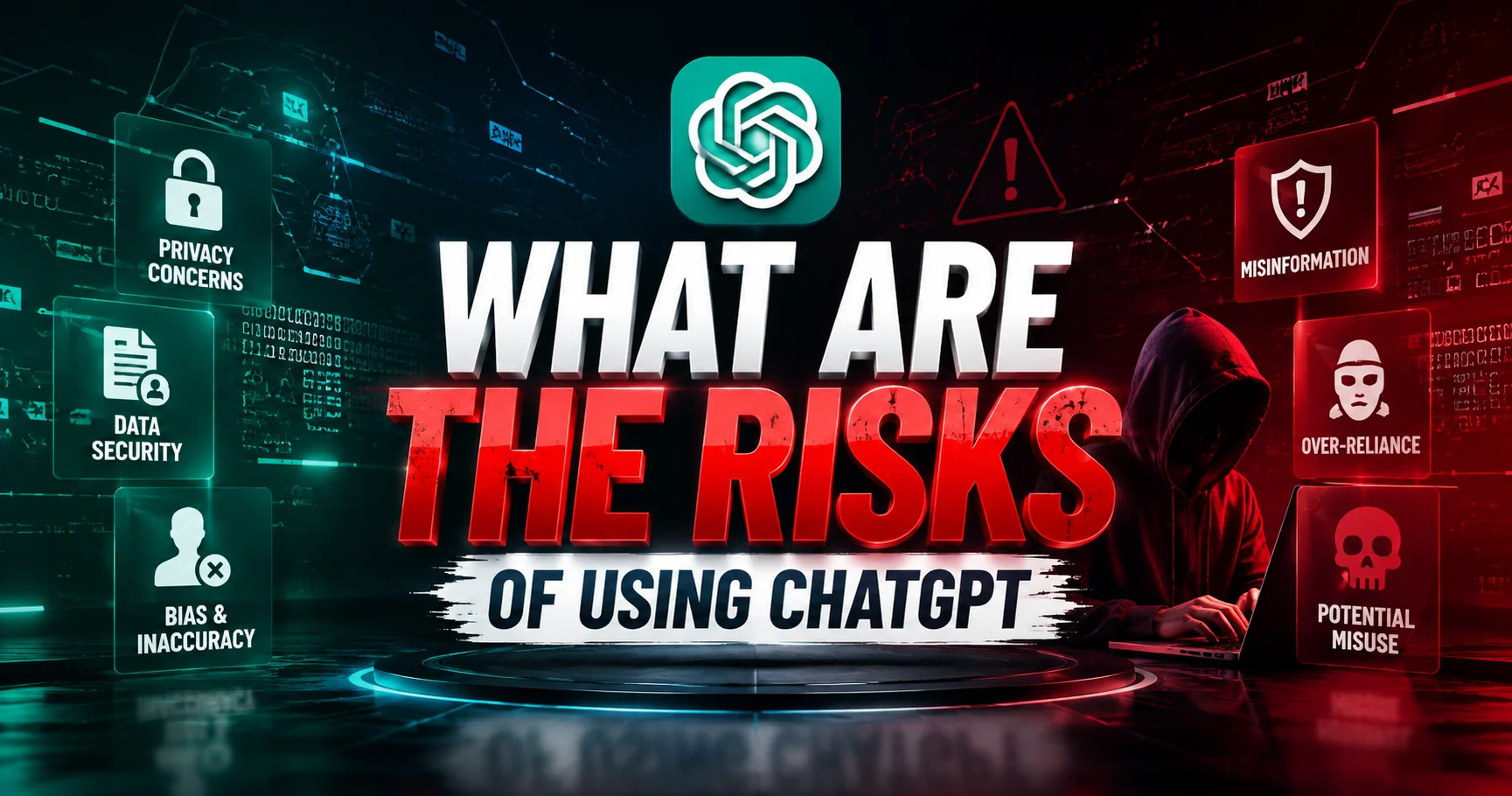
This comprehensive guide examines what are the risks of using ChatGPT in detail, exploring everything from privacy violations and data security threats to bias, misinformation, and legal implications. Whether you are a casual user, business professional, educator, or developer integrating AI into your workflow, understanding these risks is essential for responsible and safe AI usage.
The rapid advancement of AI technology means that regulations and safeguards are still catching up. In this environment, individual awareness becomes crucial. By the end of this guide, you will have a thorough understanding of the ChatGPT risks landscape and practical strategies to protect yourself and your organization.
Understanding ChatGPT and Its Growing Popularity
ChatGPT represents a significant milestone in artificial intelligence development. Built on OpenAI’s GPT (Generative Pre-trained Transformer) architecture, this conversational AI can understand and generate natural language with unprecedented coherence and contextual awareness.
How ChatGPT Works
To appreciate the risks, it helps to understand how ChatGPT operates. The model is trained on vast amounts of text data from the internet, books, articles, and various other sources. Through deep learning techniques, it learns patterns, relationships, and structures in language, enabling it to generate responses that mimic human communication.
However, this training process is where many risks originate. ChatGPT does not truly “understand” information in the human sense. It predicts the most likely sequence of words based on patterns in its training data. This probabilistic approach, while powerful, creates fundamental vulnerabilities.
The Appeal of ChatGPT
The rapid adoption of ChatGPT is driven by its remarkable capabilities:
- Versatility: ChatGPT can write emails, create code, generate creative content, answer questions, and assist with research.
- Accessibility: The user-friendly interface makes advanced AI accessible to everyone.
- Speed: Tasks that might take hours can be completed in seconds.
- Cost-effectiveness: Compared to hiring professionals for certain tasks, ChatGPT offers a low-cost alternative.
Expert Tip: “Organizations need to understand that while ChatGPT can enhance productivity, it should supplement human expertise rather than replace critical thinking. The goal should be human-AI collaboration, not AI substitution.” – Dr. Sarah Johnson, AI Ethics Researcher
Scale of Adoption and Growing Concerns
The widespread integration of ChatGPT into daily workflows has magnified the potential impact of its risks. From students using it for assignments to businesses relying on it for customer service and content creation, the stakes are high.
Major Security and Privacy Risks
When exploring what are the risks of using ChatGPT, security and privacy concerns rank among the most critical issues.
Data Privacy and Storage Concerns
Every interaction with ChatGPT becomes part of the system’s data ecosystem. The platform stores conversations, user inputs, and associated metadata, creating substantial privacy implications.
What Happens to Your Data
- Conversation Storage: ChatGPT logs all user interactions for training purposes, improvement, and safety monitoring.
- Metadata Collection: The system collects IP addresses, device information, browser details, and usage patterns.
- Potential Access: OpenAI employees and contracted reviewers may access anonymized conversations to improve the model.
Data Exposure Examples
Consider these scenarios where personal privacy could be compromised:
- Sensitive Information Input: A user shares confidential business strategy, personal health concerns, or financial details in a conversation. This data becomes part of the system’s training database.
- Identifying Information: Mentioning names, locations, contact details, or other identifying information during conversations creates privacy risks.
- Accidental Data Sharing: Users may inadvertently input sensitive client information while seeking assistance with business tasks.
Real-World Incident: In March 2023, a bug in ChatGPT exposed the chat history and payment information of some users. While this was quickly resolved, it highlighted the vulnerability of the system to technical errors and security breaches.
Potential Data Breaches
ChatGPT’s centralized data storage creates a high-value target for cybercriminals. A successful breach could expose millions of user conversations containing sensitive information.
Cybersecurity Vulnerabilities
- Infrastructure Targets: The servers storing ChatGPT data represent a lucrative target for hackers.
- Third-Party Risks: APIs and integrations with other services create additional attack vectors.
- Insider Threats: Employees with system access could potentially misuse or leak data.
Impact of Data Breaches
The consequences of a successful attack could include:
- Identity theft
- Corporate espionage
- Personal blackmail
- Financial fraud
- Reputational damage
ChatGPT Data Retention Policies
Understanding the data lifecycle is crucial for assessing ChatGPT risks.
How Long Is Data Stored
OpenAI retains user data indefinitely unless users specifically request deletion. Even then, data used for model training cannot be fully removed from the trained model.
Data Usage and Sharing
- Third-Party Sharing: OpenAI may share aggregated or anonymized data with partners.
- Legal Compliance: Data may be disclosed to law enforcement or government agencies under certain circumstances.
- Acquisition Risks: If OpenAI is acquired, data policies could change dramatically.
Advice Tip: Never share sensitive personal, financial, or confidential information with ChatGPT. Treat every conversation as potentially public.
AI Bias and Discrimination Issues
Understanding what are the risks of using ChatGPT requires examining how bias manifests in AI systems.
Training Data Bias
ChatGPT learns from internet data, which contains historical and societal biases. These biases become embedded in the AI’s responses.
Types of Bias in ChatGPT
Gender Bias: The model may associate certain professions, traits, or behaviors with specific genders based on patterns in training data.
Racial and Ethnic Bias: Historical prejudices and underrepresentation in training data can lead to stereotypical or discriminatory responses.
Socioeconomic Bias: The model may reflect biases related to income, education, and social status.
Cultural Bias: Western-centric perspectives may dominate responses, marginalizing other cultural viewpoints.
Real-World Discrimination Examples
Several documented cases illustrate how ChatGPT’s biases create real-world harm:
- Employment Discrimination: When asked to generate resumes or job descriptions, ChatGPT has shown gender and racial biases in candidate preferences.
- Content Moderation: Biased systems can unfairly flag or remove content from certain communities.
- Healthcare: ChatGPT might provide different medical advice based on demographic information, potentially exacerbating healthcare disparities.
- Legal Sentiment: AI tools used in criminal justice have demonstrated bias against minority defendants.
Expert Quote: “The greatest risk with AI bias isn’t intentional discrimination but the subtle reinforcement of existing societal inequalities through automated systems that appear neutral.” – Prof. Michael Chen, AI Ethics Initiative
Fairness in AI Systems
Efforts to create fairer AI systems face significant challenges:
- Identifying Bias: Many biases are implicit and difficult to detect.
- Mitigation Challenges: Removing bias without compromising accuracy is technically complex.
- Trade-offs: Fairness interventions may reduce performance on certain tasks.
Misinformation and Inaccurate Information
When users ask what are the risks of using ChatGPT, concerns about accuracy and reliability consistently emerge.
Hallucinations in AI
One of the most significant ChatGPT risks is its tendency to “hallucinate”—generating false information presented with high confidence.
What Are AI Hallucinations
Hallucinations occur when ChatGPT creates plausible-sounding but entirely incorrect information. This happens because the model generates responses based on patterns rather than verified facts.
Types of Hallucinations
- Factual Errors: Incorrect statements about history, science, or current events.
- Source Fabrication: Creating fake citations, references, or expert quotes.
- Mathematical Mistakes: Errors in calculations or logical reasoning.
- Contextual Confusion: Misinterpreting or misapplying information.
Factual Errors and Their Impact
The consequences of AI hallucinations can be severe:
Academic Misinformation: Students using ChatGPT for research may incorporate fabricated information into papers, spreading false knowledge.
Medical Risks: Users seeking health advice might receive dangerous recommendations or false diagnoses.
Legal Consequences: Incorrect legal information could lead to bad decisions or violations.
Financial Loss: Inaccurate business or investment advice could result in financial harm.
Verification Challenges
The persuasive nature of ChatGPT’s responses makes misinformation particularly dangerous:
- Convincing Presentation: Responses appear well-researched and confident, masking their unreliability.
- No Fact-Checking: The model cannot distinguish between truth and falsehood.
- Context Limitations: ChatGPT lacks real-time awareness and may not know recent developments.
- Copying Mistakes: The model may replicate and amplify existing errors from its training data.
Expert Tip: Always verify ChatGPT information through reliable, authoritative sources. Cross-reference facts, check citations, and use fact-checking tools before depending on AI-generated content.
Example of Misinformation Incident
A journalist used ChatGPT to verify information for an article. The AI confidently fabricated quotes and attributed them to an author who had never made those statements. This incident nearly led to the publication of false information and damaged the journalist’s professional credibility.
Plagiarism and Intellectual Property Concerns
Academic integrity and intellectual property rights face new challenges with ChatGPT’s capabilities.
Copyright Infringement Risks
ChatGPT training data includes copyrighted material, raising questions about the originality of its outputs.
Key Copyright Issues
- Derivative Works: ChatGPT outputs may substantially reproduce copyrighted text without transformation.
- Unattributed Use: Users may present AI-generated content as original work, violating copyright.
- Fair Use Uncertainty: The legal boundaries of fair use for AI training and outputs remain unclear.
Academic Integrity Issues
Educational institutions grapple with ChatGPT use affecting academic integrity:
- Student Submissions: AI-generated assignments undermine learning objectives.
- Plagiarism Detection: Traditional detection methods struggle to identify AI-generated content.
- Ethical Concerns: Students may achieve grades they don’t deserve, devaluing education.
Attribution and Originality
Proper Attribution: When using ChatGPT outputs, clear disclosure is essential for professional and academic contexts.
Compliance with Policies: Many organizations and institutions have policies regarding AI-generated content.
Ethical Publishing: Journals and publishers increasingly require disclosure of AI involvement in research and publications.
Advice Tip: When using ChatGPT for professional work, disclose AI assistance, verify accuracy, and maintain human oversight of final outputs.
Professional and Business Risks
Businesses integrating ChatGPT face specific risks that require careful management.
Reliance on AI for Decision Making
ChatGPT’s impressive capabilities may tempt businesses to delegate critical decisions to AI, creating substantial risk.
Decision-Making Vulnerability
- Lack of Nuance: ChatGPT cannot understand complex contextual factors.
- Absence of Accountability: The model cannot be held responsible for decisions.
- Bias Amplification: Business decisions may inherit and amplify AI biases.
Confidential Business Information Exposure
Employees using ChatGPT for work-related tasks may inadvertently expose sensitive business data:
- Strategic Information: Business plans, strategies, and confidential projects.
- Client Data: Customer information, contracts, and proprietary data.
- Financial Information: Budgets, projections, and financial documents.
- Intellectual Property: Trade secrets, patents, and proprietary technology.
Reputation Damage
Incorrect or inappropriate ChatGPT outputs can significantly damage professional reputation:
- Incorrect Information: Publishing AI-generated errors creates credibility issues.
- Inappropriate Content: ChatGPT may generate offensive or insensitive content.
- Quality Perception: AI-generated material may be lower quality than expert-created content.
Real Business Risk Scenario
A financial services firm used ChatGPT to draft client communications. The AI generated responses containing incorrect regulatory information, potentially exposing the firm to liability and damaging client trust.
Expert Quote: “AI should be treated as an assistant, not a decision-maker. The human element remains essential for judgment, creativity, and accountability.” – Niaz Khan, Senior SEO Expert
Psychological and Social Impacts
The social and psychological implications of ChatGPT use represent underappreciated risks.
Over-Reliance on AI
Excessive dependence on ChatGPT can erode human capabilities:
- Critical Thinking Atrophy: Users may stop thinking critically and verifying information.
- Creativity Suppression: Reliance on AI for creative tasks may reduce original thinking.
- Skill Degradation: Professional skills may weaken from disuse.
- Memory Dependence: Users may stop retaining information, relying on AI for recall.
Human Connection Erosion
ChatGPT can affect human relationships in concerning ways:
- Emotional Substitution: Users may turn to AI instead of human connections.
- Social Skill Decline: Reduced human interaction can impair social abilities.
- Relationship Issues: AI relationships may undermine real connections.
- Dehumanization: Seeing AI as a “friend” can affect how humans treat each other.
Mental Health Considerations
ChatGPT use can have psychological effects:
- Anxiety: Fear of AI replacing jobs or making humans obsolete.
- Isolation: Reduced human interaction leads to loneliness.
- Reality Confusion: Difficulty distinguishing AI-generated content from reality.
- Attachment: Users may develop emotional attachments to AI, creating dependency.
Financial and Economic Risks
Understanding what are the risks of using ChatGPT includes examining its economic implications.
Job Displacement Concerns
Automation through AI represents one of the most significant ChatGPT risks:
Affected Professions
- Content Creation: Writers, journalists, and copywriters face competition.
- Customer Service: AI-powered chatbots replace human agents.
- Data Analysis: Automated analysis reduces need for analysts.
- Translation: Machine translation threatens interpreter roles.
Economic Consequences
- Income Disparity: AI benefits may accrue to platform owners and tech companies.
- Retraining Challenges: Affected workers need significant reskilling.
- Economic Transition: Shifting industries may create economic disruption.
Cost Implications
While ChatGPT appears cost-effective, hidden costs exist:
- Implementation Costs: Enterprise integration requires investment.
- Training Needs: Staff need training for effective AI use.
- Security Investment: Protecting against AI risks requires resources.
- Quality Control: Monitoring and verification costs add expense.
Market Manipulation
ChatGPT could be used for financial market manipulation:
- Fake Reviews: Generating false reviews to manipulate ratings.
- Misinformation: Spreading false information for market impact.
- Fraud: Creating convincing scams and fraudulent content.
Regulatory and Legal Risks
Compliance Issues
Organizations using ChatGPT must navigate complex regulatory requirements:
Key Compliance Areas
- Data Protection: GDPR, CCPA, and other privacy regulations require data handling compliance.
- Accuracy Requirements: Regulated industries demand information accuracy.
- Transparency Laws: Some sectors require disclosure of AI use.
Privacy Law Violations
Using ChatGPT with personal data can violate privacy laws:
- Data Subject Rights: Processing personal data through ChatGPT may violate individual rights.
- Cross-Border Transfer: ChatGPT’s international data flow may violate regulations.
- Consent Requirements: Users may be required to obtain consent for data processing.
Liability Questions
Who bears responsibility for ChatGPT’s mistakes remains uncertain:
- Developer Liability: To what extent is OpenAI responsible?
- User Responsibility: What is the user’s legal burden?
- Insurance Coverage: Does liability insurance cover AI-generated errors?
Technical Vulnerabilities
Prompt Injection Attacks
Prompt injection represents a significant security risk:
How Prompt Injection Works
Attackers craft prompts that circumvent ChatGPT’s safety measures, causing the model to:
- Generate harmful content
- Expose sensitive information
- Perform unauthorized actions
Model Manipulation
Adversarial attacks can manipulate ChatGPT’s behavior:
- Bypassing Safety Filters: Crafting prompts that get around content restrictions.
- Data Poisoning: Feeding harmful data to influence model behavior.
- Spoofing: Making the model impersonate individuals or entities.
Security Exploits
ChatGPT integration creates new attack surfaces:
- API Vulnerabilities: Weak API security exposes systems to attacks.
- Automated Attacks: Scaled attacks through AI automation.
- System Exploitation: ChatGPT features may be exploited to compromise systems.
Risk Mitigation Strategies
Understanding what are the risks of using ChatGPT is only the first step. Implementing protection strategies is essential.
Safe Usage Practices
Personal Users:
- Avoid Sensitive Information: Never share personal, financial, or health details.
- Don’t Share Credentials: Never input passwords, account numbers, or security codes.
- Anonymize Data: Remove identifying information from queries.
- Maintain Accounts: Create separate accounts for different purposes.
Business Users:
- Data Classification: Identify and protect sensitive data categories.
- Access Controls: Restrict ChatGPT access to authorized personnel.
- Usage Policies: Create clear guidelines for AI use.
- Data Masking: Remove sensitive information before input.
Verification Protocols
Effective verification protects against misinformation:
- Fact-Checking: Verify claims through authoritative sources.
- Source Assessment: Check cited sources for legitimacy.
- Consistency Checking: Cross-reference with multiple sources.
- Expert Consultation: Consult domain experts for validation.
Security Implementation
Protecting systems and data:
- Encryption: Ensure all communications and data are encrypted.
- Monitoring: Track ChatGPT usage for suspicious patterns.
- Auditing: Regularly audit AI-assisted processes.
- Incident Response: Prepare for potential data breaches.
Expert Tip: “The safest approach to ChatGPT use assumes the worst-case scenario. Treat every conversation as public, every output as potentially incorrect, and every AI suggestion as requiring human verification.” – Niaz Khan
Future Outlook and Emerging Risks
Anticipating New Challenges
As AI technology evolves, new risks will emerge:
- Advanced Manipulation: More sophisticated manipulation techniques.
- Integration Risks: Deeper system integration increases vulnerabilities.
- Autonomous Systems: AI making decisions with less human oversight.
- Quantum Computing: Future quantum AI creates new challenges.
Addressing Unknowns
Risk mitigation must anticipate future developments:
- Continuous Learning: Staying informed about emerging risks.
- Adaptive Strategies: Updating security approaches as technology evolves.
- Proactive Investment: Investing in research and readiness.
Case Studies of Real ChatGPT Incidents
Case Study 1: Data Exposure in Business
A marketing agency used ChatGPT to generate content for clients, including sensitive campaign strategies. An employee input confidential client information into ChatGPT without realizing the data was being stored. The agency’s proprietary information became part of ChatGPT’s training data, risking competitive damage.
Key Lesson: Treat any information entered into ChatGPT as potentially exposed.
Case Study 2: Misinformation in Academic Publishing
A graduate student used ChatGPT to assist with research. The AI generated convincing citations that appeared legitimate but were entirely fabricated. The student submitted the paper, and the fabrication was discovered, resulting in academic misconduct proceedings.
Key Lesson: Never rely on ChatGPT citations without verification.
Case Study 3: Business Reputation Risk
A medium-sized business used ChatGPT for social media content creation. The AI generated posts that, while grammatically correct, contained culturally inappropriate content that offended customers. The resulting social media backlash caused significant reputational damage.
Key Lesson: Human review of AI-generated content is essential, especially for public-facing materials.
Frequently Asked Questions
Q: Is ChatGPT safe to use for personal information?
A: ChatGPT is not safe for sharing personal or sensitive information. The platform stores conversations and may use them for training. Never share identifying information, financial details, or confidential content.
Q: Can ChatGPT be trusted for medical advice?
A: ChatGPT should never be trusted for medical advice. The model’s lack of medical expertise, tendency to hallucinate, and inability to understand individual health contexts make it dangerous for health-related decisions.
Q: Is using ChatGPT for work a security risk?
A: Yes, using ChatGPT for work can be a significant security risk. Employees may inadvertently share confidential business information, proprietary data, or client details. Businesses should implement strict policies and controls for AI use.
Q: Can ChatGPT plagiarize content?
A: ChatGPT can generate content that closely resembles or reproduces copyrighted material. The model’s training on internet content creates potential copyright and plagiarism issues.
Q: Is ChatGPT biased in its responses?
A: ChatGPT contains biases inherited from its training data. The model may generate stereotypical, discriminatory, or prejudiced responses, particularly about gender, race, and culture.
Q: Can ChatGPT be hacked?
A: ChatGPT’s infrastructure can be vulnerable to hacking and attacks. Prompt injection techniques and adversarial inputs can manipulate the model’s behavior.
Q: Does ChatGPT have legal protections?
A: ChatGPT provides limited legal protections. Users bear responsibility for the content generated through the platform. Regulatory compliance and liability remain complex and evolving.
Q: Is ChatGPT dangerous for society?
A: ChatGPT creates significant societal risks including job displacement, misinformation spread, and social changes. While beneficial for many applications, the dangers require careful management.
Q: Can ChatGPT access the internet?
A: ChatGPT does not have real-time internet access. Its knowledge is limited to training data and may not include recent events. This limitation contributes to hallucination risks.
Q: How can I verify ChatGPT information?
A: Always verify ChatGPT information through authoritative sources. Cross-reference claims, check citations, and consult domain experts for critical decisions.
Conclusion
The question “what are the risks of using ChatGPT” reveals a complex landscape of challenges that span privacy, security, accuracy, bias, legality, and social impact. Understanding these ChatGPT risks is essential for responsible AI use.
While ChatGPT offers transformative benefits across numerous applications, the risks are substantial and require careful consideration. Data privacy concerns demand that users treat every interaction as potentially public. Security vulnerabilities highlight the importance of protecting sensitive information. Bias in responses reminds us that AI reflects societal prejudices and requires correction.
Misinformation and inaccuracies demonstrate the critical need for verification, particularly in professional, academic, and medical contexts. The potential for plagiarism and intellectual property violations underscores the importance of ethical AI use and proper attribution.
Businesses must guard against over-reliance on AI for decision-making while protecting confidential information. Social and psychological impacts—including erosion of critical thinking, human connection, and mental well-being—demand balanced and thoughtful use of AI tools.
The Path Forward
Responsible ChatGPT use requires:
- Education: Understanding the risks and limitations of AI.
- Verification: Always verifying AI-generated content.
- Protection: Safeguarding sensitive information.
- Oversight: Maintaining human judgment and accountability.
- Ethics: Using AI tools responsibly and transparently.
As AI technology continues its rapid evolution, staying informed about ChatGPT risks and emerging dangers becomes increasingly important. By approaching AI tools with awareness and caution, we can harness their benefits while protecting ourselves, our organizations, and society.
Premium Tips from Niaz Khan Expert
📌 Essential ChatGPT Safety Rules
- The Golden Rule of ChatGPT Use: “If you wouldn’t post it on social media, don’t post it in ChatGPT.” This simple rule protects you from the most significant ChatGPT risks.
- Always Use the Incognito Method: Create separate ChatGPT accounts for different purposes—one for personal use, one for professional work. This prevents cross-contamination of sensitive information.
- The 24-Hour Verification Rule: Never act on ChatGPT information within 24 hours of receiving it. Use this cooling-off period to verify facts, consult experts, and think critically about responses.
- Credential Compartmentalization: Never store passwords, API keys, or access credentials anywhere near your ChatGPT workflow. Use secure password managers and keep them completely separate.
- Screen-Shot Documentation: Take screenshots of important ChatGPT conversations for your records. This provides evidence if you need to prove what the AI recommended.
- The Backup Brain Principle: Treat ChatGPT as a backup to your brain, never your primary brain. Maintain your skills, critical thinking, and independent decision-making abilities.
- Domain-Specific Verification: For professional work, always have domain experts review any ChatGPT-generated content. AI lacks specialized knowledge and context.
- The Search Engine Cross-Check: Before using any ChatGPT information, find at least three authoritative sources that confirm it. If you can’t, don’t use it.
- Version Awareness: Know which ChatGPT version you’re using. Different versions have different capabilities, limitations, and risks.
- Regular Privacy Audits: Periodically review your ChatGPT account, delete conversations you no longer need, and check privacy settings.
🛡️ Protecting Your Business
For organizations integrating ChatGPT:
- Create comprehensive AI usage policies
- Train employees on ChatGPT risks
- Implement data loss prevention measures
- Regular security audits and monitoring
⚠️ Red Flags to Watch For
- ChatGPT providing extremely confident, specific information without sources
- Responses that seem too good to be true
- Generated content that matches your proprietary information
- AI avoiding questions or providing inconsistent answers
🔍 Continuous Learning
- Follow AI ethics research and regulatory developments
- Subscribe to security and AI news sources
- Participate in AI safety communities and discussions
Disclaimer:
This article provides general information about ChatGPT risks and safety considerations. It is not a substitute for professional legal, security, or compliance advice. Users should consult qualified professionals for specific concerns about data security, privacy compliance, and regulatory requirements. The examples and information provided are for educational purposes only and do not constitute professional recommendations.
Written By Niaz Khan