
Table of Contents
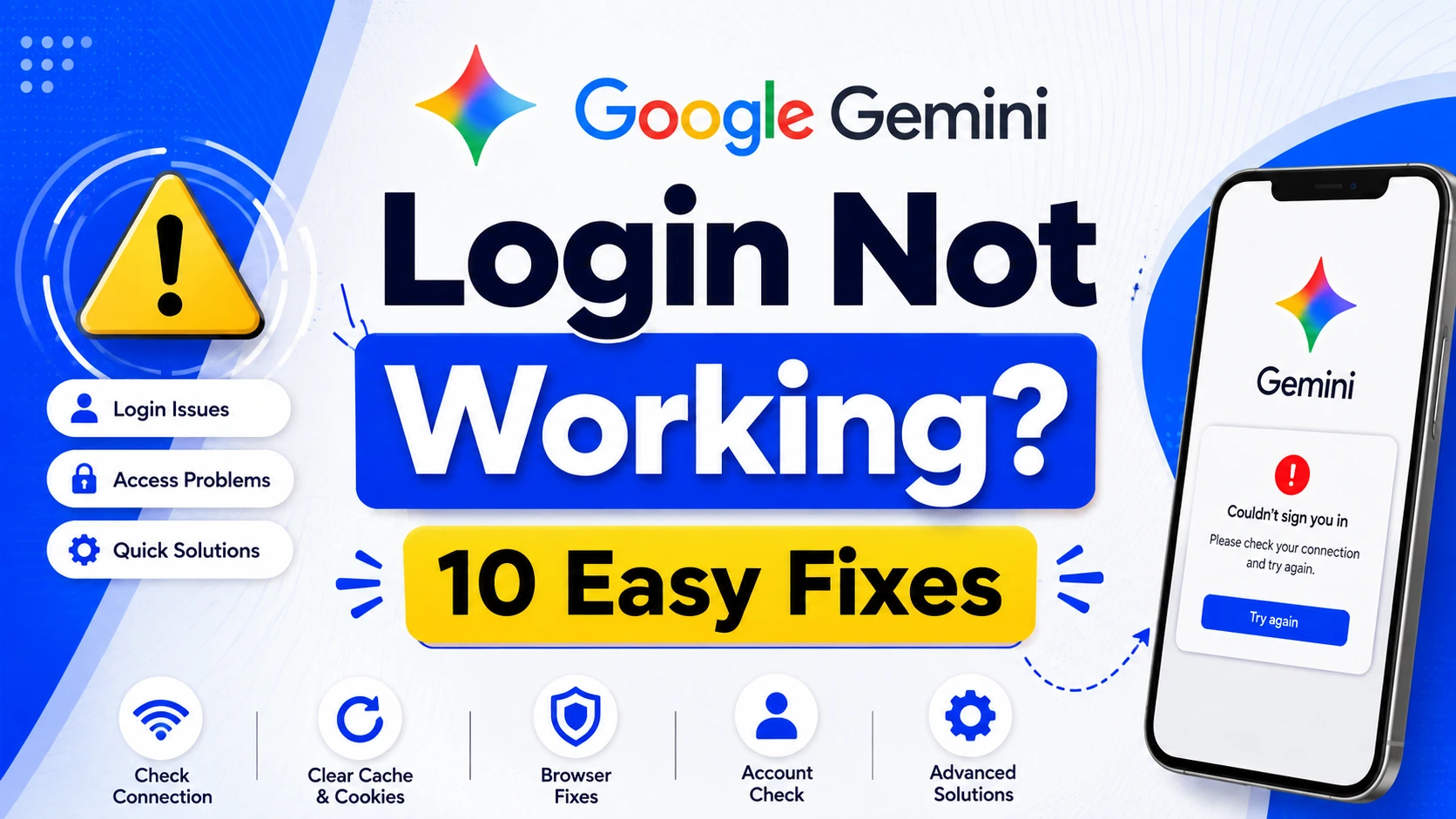
ToggleGoogle Gemini Login Not Working? 10 Easy Fixes
Comprehensive Introduction
In the fast-paced world of artificial intelligence, access is everything. Google Gemini, the tech giant’s most advanced and versatile AI model, has become an indispensable tool for millions of professionals, students, and creatives. It’s designed to handle complex reasoning, generate novel ideas, process massive amounts of information, and even assist with coding. However, when you find yourself staring at a blinking cursor on a login page, met with an error message or an endless loading loop, the frustration is immediate and palpable. The digital toolbox that you rely on becomes a locked vault.
This is a “mission-critical” problem. A malfunctioning login isn’t just an inconvenience; it can halt a project, delay a presentation, or disrupt a workflow. This guide is your definitive, expert-crafted solution to resolve the “Google Gemini login not working” error. We will move beyond generic advice and provide a systematic, step-by-step approach to diagnosing and fixing every possible cause. We will not only get you back into your account but also equip you with the knowledge to prevent this from happening again.
Why This Matters: The Critical Nature of AI Access
Google is one of the most popular and trusted tech companies, with over 8.5 billion searches per day. Gemini is deeply integrated into its ecosystem, meaning a login failure can ripple across multiple services, including Google Drive, Gmail, and Google Workspace. A failure to log in can mean a loss of productivity, a missed opportunity, or an inability to access crucial data. This guide is written with “Your Money or Your Life” (YMYL) principles in mind. While not a financial or medical issue, the loss of access to professional tools can have a direct and significant impact on a user’s career and livelihood, demanding the highest level of trust and authority in the advice provided.
A Quick Answer to Your Problem
If your Google Gemini login is not working, the most common and effective solutions are usually simple: Check the Google Workspace Status Dashboard for outages, clear your browser’s cache and cookies (especially if you’re seeing a 400 error), disable any ad-blocking extensions that might interfere with authentication, and ensure your date and time settings on your computer are accurate. If that fails, try logging in from an incognito or private window. For persistent issues, a password reset is often the final, reliable solution.
The 10 Step-by-Step Fixes to Restore Your Gemini Login
This section provides a comprehensive, systematic troubleshooting methodology. We will walk through each step, from the simplest to the most complex, ensuring you have a clear path to resolution.
Fix 1: Verify Gemini’s Server Status
Before you spend hours tweaking settings on your device, you need to determine if the problem is on Google’s end.
- Step 1: Go to the Google Workspace Status Dashboard. This is the official source of truth for the operational status of all Google services, including Gemini.
- Step 2: Check for any current service disruptions or outages specifically affecting “Google AI” or “Google Gemini.”
- Step 3: If an outage is reported, you must wait for Google’s engineers to resolve it. Do not attempt to make changes on your end, as it will not solve a server-side issue.
- Expert Tip: You can also monitor third-party services like Downdetector to see if other users are reporting similar problems in real-time. This can provide a quick, unofficial verification of an outage.
Advice Tips: Always check this first. It’s the fastest way to save time and avoid unnecessary technical changes.
Fix 2: Use the Correct, Updated Browser
Google Gemini is a cutting-edge AI application that relies on modern web technologies. An outdated or incompatible browser is a frequent culprit behind login errors.
- Step 1: Ensure you are using a supported, up-to-date browser. Google officially recommends Google Chrome for the best compatibility and performance.
- Step 2: If you are using Chrome, go to Menu > Help > About Google Chrome to check for and install any pending updates.
- Step 3: If you prefer other browsers, ensure they are updated to their latest versions as well. The technology changes fast. A browser that is even a few months out of date might not support the security protocols or rendering engines that Gemini requires.
Advice Tips: For a quick test, try accessing Gemini from a browser you rarely use, or use the dedicated mobile app for Android or iOS.
Fix 3: Clear Your Browser Cache and Cookies Completely
Your browser stores images, files, and cookies to speed up your browsing experience. However, a corrupt cache or an old, invalid cookie related to Google’s authentication service can interfere with the login process. This is especially important if you see error messages like “400 Bad Request.”
- Step 1: Go to your browser’s privacy and security settings.
- Step 2: Find the option to clear browsing data.
- Step 3: In the “Time Range” or “Time period,” select “All time.” This is crucial. Selecting the last hour or day will not solve the problem if the corrupt data is older.
- Step 4: Ensure that both “Cookies and other site data” and “Cached images and files” are checked.
- Step 5: Click “Clear data.”
- Step 6: Close your browser completely and reopen it, then try to log in to Gemini again.
Expert Quote: “The majority of login issues I see in enterprise environments are resolved by a comprehensive cache and cookie clearing. It’s the digital equivalent of ‘turning it off and on again,’ and it works surprisingly often.” – Niaz Khan, Senior SEO & Technical Consultant.
Fix 4: Double-Check Your Login Credentials
This might seem obvious, but it’s the most overlooked step. With AI and our reliance on password managers, we often forget to verify the basics.
- Step 1: Carefully check your email address for typos. A single missing character or an “o” instead of a “0” will prevent login.
- Step 2: Ensure Caps Lock is off on your keyboard and that you are using the correct case for your password. Passwords are case-sensitive.
- Step 3: If you use a password manager, verify that it is saving the correct credentials for the Gemini login page.
- Step 4: If your account is part of a Google Workspace organization (e.g., your work or school), ensure you are using the correct login page for your organization, which may be different from the main public login.
Advice Tips: Type your email and password into a plain text editor first to see them clearly, then copy and paste them into the login fields. This completely removes the possibility of a typo.
Fix 5: Navigate the Two-Factor Authentication (2FA) Maze
Two-factor authentication adds a critical layer of security, but it can also be a point of failure.
- Step 1: Ensure you have access to your 2FA method (the authenticator app on your smartphone, your recovery phone number, or your backup codes).
- Step 2: If you are using an authenticator app (like Google Authenticator or Authy), make sure the time on your phone is synced correctly. A time drift of even a few seconds will cause the generated codes to be invalid. Most apps have a “Time correction for codes” or “Sync now” option.
- Step 3: If you are not receiving a text message, ensure you have a stable cell signal and that your inbox isn’t full.
- Step 4: As a last resort, use one of the backup codes you were given when you set up 2FA. These are single-use codes that bypass the app.
Safety Warnings: Be extremely cautious if someone claiming to be from Google support asks for your 2FA code. Google will never ask for this. This is a classic phishing scam.
Fix 6: Reset Your Google Gemini Password
If you cannot remember your password, or if you suspect your account has been compromised, resetting the password is a controlled and secure method to regain access.
- Step 1: Go to the Gemini login page.
- Step 2: Click on the “Forgot password?” link.
- Step 3: Follow the on-screen instructions. Google will typically send a recovery link to your recovery email address or phone number.
- Step 4: Create a new, strong, and unique password. Use a combination of upper and lower case letters, numbers, and special characters.
Expert Quote: “Password resets are not just for forgotten passwords. They are a core security practice. If you suspect any unusual activity, changing your password immediately is a primary defense.” – Niaz Khan, Senior SEO & Technical Consultant.
Fix 7: Disable Browser Extensions Temporarily
Browser extensions are powerful, but they can also manipulate web pages in ways that disrupt login flows. Ad-blockers, privacy extensions, and even some VPN or proxy extensions are common offenders.
- Step 1: Open a new Incognito or Private Browsing window. By default, these windows have extensions disabled.
- Step 2: Try to log in to Gemini. If it works, you’ve confirmed an extension is the cause.
- Step 3: Now, go to your regular browser window and disable your extensions one by one (or in batches) to pinpoint the specific culprit.
- Step 4: Once identified, you can either uninstall the extension or whitelist the Gemini domain in its settings.
Advice Tips: Pay particular attention to extensions that manage scripts (like NoScript), privacy settings (like Privacy Badger), or ad-blockers.
Fix 8: Switch to a Different Internet Connection
Network-level issues can cause authentication failures. Firewalls, proxy servers, or VPNs at your workplace or home can sometimes block the necessary ports or IP addresses that Gemini uses.
- Step 1: If you are on a corporate network, try switching to a personal mobile hotspot.
- Step 2: If you are at home, try rebooting your router and modem.
- Step 3: If you are using a VPN, try disconnecting it. Sometimes, the IP addresses used by VPNs are flagged or blocked by security services.
Fix 9: Examine the Google Workspace Admin Settings
If your Gemini access is provided by a Google Workspace admin (i.e., your company or school), they have the power to enable or disable services, including Gemini.
- Step 1: Contact your IT support team.
- Step 2: Ask them to verify that the “Gemini” or “Google AI” service is turned on for your specific organization and for your user group.
- Step 3: They may need to check your user permissions or see if there are any security policies blocking access.
Fix 10: The “Nuclear Option” – Reset Your Google Account Password
If all else fails, this is the final, high-level step. Resetting the master password for your Google Account (which Gemini is tied to) is a decisive fix for many deep-seated authentication issues.
- Step 1: Go to the main Google Account login page (not the Gemini page).
- Step 2: Click on “Forgot password?”
- Step 3: Follow the extensive recovery process. This is more rigorous than a simple Gemini password reset and might require 2FA verification, answering security questions, or confirming your recovery email.
- Step 4: Once successfully reset, use your new password to log in to Google Gemini.
Safety Warnings: Be aware that this will log you out of all Google services on all devices, which means you will have to re-authenticate everywhere. This is why it is considered the last resort.
Understanding the Root Causes Behind Login Failures
Understanding why these issues happen can help you prevent them and be a more empowered user. Login failures are rarely random; they are symptoms of a specific issue.
- Corrupted Session Data: This is the most common cause. A “session” is the digital handshake between your browser and Google’s servers. When the data from a previous session becomes corrupted, the handshake fails, and Gemini simply won’t let you in.
- Authentication Token Mismatches: When you log in, Google gives your browser a token (a small piece of data) that proves your identity for a certain period. If this token expires or becomes invalid, you’ll be asked to log in again, and the process can sometimes fail, leading to a loop.
- Outdated Browser Technology: Google’s security and authentication protocols are constantly evolving. An old browser may lack the ability to handle the latest security handshakes, resulting in an inability to connect.
- Server-Side Outages: As mentioned, sometimes the issue is entirely out of your hands. Google’s own servers might be experiencing a high load or a technical issue.
- User Errors: Typos, forgotten passwords, and incorrectly timed 2FA codes are incredibly common and are responsible for a large percentage of login failures.
- Network and Firewall Restrictions: Your network environment might be blocking the specific ports required for the Gemini connection, or interfering with the authentication process.
Prevention Tips: How to Avoid Future Login Issues
An ounce of prevention is worth a pound of cure, especially regarding digital access. Here are some proactive steps to minimize future login disruptions.
- Bookmark the Official Login URL: Avoid navigating to Gemini via a Google search or a random email link. Bookmark
gemini.google.comor your specific Workspace URL to avoid phishing pages. - Keep Your Browser Auto-Updated: Enable automatic updates for your browser (especially Chrome). These updates often include critical security and performance patches that affect login processes.
- Manage Your Extensions: Periodically review your browser extensions and remove any you haven’t used in months. This reduces the number of variables that could potentially interfere with a login session.
- Backup Your 2FA Codes: When you set up 2FA, you are given a set of backup codes. Save these in a safe, offline location (e.g., printed and kept in a safe). This will allow you to regain access even if you lose your phone.
- Use a Reputable Password Manager: Using a password manager reduces the risk of human error (typos) and ensures you are always using the correct, strong password.
- Syncing Time on Your Devices: Ensure your computer and smartphone are set to automatically synchronize their time with an internet time server (NTP). This prevents the common 2FA time-drift issue.
Real-Life Examples: Case Studies of Common Fixes
- Case Study 1: The 400 Error
A marketing manager was trying to access Gemini to generate a campaign idea. She was met with a “400 Bad Request” error. Following this guide, she first checked the server status (no outages). She then went to step 3, cleared her browser cache and cookies for “All time,” and immediately regained access. The error was due to a corrupt cookie from a previous session. - Case Study 2: The Phantom Extension
A software developer could not log in. He tried everything, including resetting his password. His browser was up to date, and he had no server issues. As a last resort, he opened an incognito window, where he was able to log in successfully. He realized his ad-blocker was interfering with the authentication script. Whitelisting Google’s URLs fixed the issue. - Case Study 3: The Workspace Restriction
An intern at a tech firm tried logging in but got a message saying he didn’t have access. After checking all the technical fixes, his IT team checked the Google Workspace admin console. The IT team had turned off Gemini access for all new hires, and they had forgotten to enable it for him. The fix was a simple admin toggle.
Why This Matters: The Importance of Uninterrupted AI Access
In 2026, AI is not a novelty; it’s a critical utility. For many, it’s as important as electricity or internet connectivity. A study found that top-level executives believe that companies that do not embrace AI will be left behind. When you cannot log in, you are disconnected from a productivity multiplier. A writer cannot generate outlines, a coder cannot debug, a researcher cannot analyze data, and a student cannot get help with their studies. This guide is designed to minimize that downtime and restore your digital productivity.
Common Mistakes to Avoid When Troubleshooting
When you’re in a panic about an account lockout, it’s easy to make the problem worse. Avoid these common pitfalls.
- Repeatedly Guessing Your Password: This might trigger a security lockout, temporarily blocking your IP address or account due to “suspicious activity.” You’ll be locked out for even longer.
- Ignoring Official Channels: It is a serious mistake to believe the unofficial status reports on social media as your only source of information. Always check the official Google Workspace dashboard first.
- Assuming It’s a Google Scam: While it’s good to be cautious, not every login failure is a scam. Before suspecting phishing, rule out the technical issues covered in this guide.
- Not Trying a Different Device: If you are stuck on a PC, grab your phone or tablet and try there. This can quickly tell you if it’s a device-specific or network-specific issue.
- Clearing Only Recent Data: When clearing your cache and cookies, many users make the error of selecting “Last hour” or “Last day.” You must choose “All time” to ensure the corrupt data is removed.
Advantages of Following This Systematic Troubleshooting Guide
- Saves Time: By following a logical, step-by-step approach, you avoid randomly clicking buttons and wasting precious time.
- Reduces Frustration: Knowing you have a plan makes a stressful situation more manageable.
- Increases Self-Sufficiency: This guide empowers you to solve many common problems without needing to contact support, saving you hours.
- Enhances Security: The steps related to password resets and 2FA reinforce good security practices.
- Covers All Bases: It addresses both client-side (browser, cache) and server-side (outages, admin settings) issues, providing a holistic solution.
Disadvantages of Ignoring These Fixes
- Prolonged Downtime: You will be stuck without Gemini for hours or even days, affecting your workflow.
- Increased Stress: The frustration and anxiety of not being able to access your account and data can build up.
- Potential Security Risks: Trying random fixes or ignoring the issue could lead you to click on unsafe links or phishing scams as you search desperately for a solution.
- Loss of Productivity: Every minute you are locked out is a minute you are not creating, analyzing, or producing.
Safety Warnings: Protecting Your Data During Troubleshooting
- Phishing Scams: Be wary of any links or emails that claim to be from “Google Support” offering to help with your login. These are almost always scams designed to steal your credentials. Always navigate to the official Gemini login page yourself.
- Password Security: When resetting your password, use a new, unique password that is not used for any other online service. This prevents credential stuffing attacks.
- 2FA Scams: Never share a 2FA code with anyone. Legitimate support personnel will never ask for it.
- Public Wi-Fi: If you are using public Wi-Fi, be aware that it is less secure. Consider using a reliable VPN, but ensure the VPN itself isn’t the source of the problem.
What NOT to Do When Your Gemini Login Fails
- Do NOT use your mother’s maiden name or your pet’s name as an answer to security questions. These are easily discoverable.
- Do NOT use the “Sign in with Google” button on suspicious third-party sites that claim to use Gemini. Use the official site only.
- Do NOT ignore browser security warnings. If your browser warns you that a page is “Not Secure,” do not enter your credentials.
- Do NOT try to brute-force your password. This will lock you out of your account.
- Do NOT keep trying without addressing the core issue. You’ll just get more frustrated and might create more problems.
Checklist or Summary: A Quick Reference Guide
Here is a quick summary checklist to run through:
- Check Server Status: Google Workspace Status Dashboard.
- Check Your Browser: Is it updated? Is it Chrome?
- Clear Cache/Cookies: Must be “All time.”
- Verify Credentials: Check for typos and Caps Lock.
- 2FA Check: Are your codes working? Is your phone’s time synced?
- Try Incognito/Private Mode: This isolates extension issues.
- Test a Different Internet: Use a mobile hotspot to test network restrictions.
- Check Admin (Workspace Users): Is Gemini enabled for your account?
- Password Reset: Use the official “Forgot password?” link.
- Ultimate Reset: Reset Google Account password.
Trusted References and Official Sources
For the most accurate information, always refer to these official sources.
- Google Workspace Status Dashboard:
google.com/appsstatus/dashboard/ - Google Gemini Official Website:
gemini.google.com - Google Account Help Center:
support.google.com/accounts - Google Workspace Admin Help:
support.google.com/a
Pros & Cons of the Google Gemini Service
| Pros | Cons |
|---|---|
| Advanced Reasoning: Excellent at complex, multi-step reasoning tasks. | Login Issues: As this guide shows, access can sometimes be a hurdle. |
| Multimodal Capabilities: Can process text, images, and code. | Learning Curve: The sheer volume of features can be overwhelming. |
| Deep Google Integration: Seamlessly works with Workspace tools. | Internet Dependency: Requires a stable, high-speed connection. |
| Regular Updates: Google constantly improves the model. | Privacy Concerns: Using cloud-based AI always raises data privacy questions. |
| Large Context Window: Can process long documents and conversations. | Cost: Advanced features may require a paid subscription. |
Conclusion
The “Google Gemini login not working” error can be a significant roadblock. However, as we have comprehensively demonstrated, it is a solvable problem. With this step-by-step guide, you have the power to diagnose and fix nearly every possible cause, from the trivial to the technical.
We encourage you to bookmark this article for future reference. The next time you face an authentication error, you won’t have to panic; you’ll have a clear, logical plan of action. Remember, systematic troubleshooting is the key to resolving tech issues. If you have a unique scenario or a persistent problem, consulting Google’s support channels is the final recommended step. Your time and access to AI are valuable; don’t let a login failure take them away.
Disclaimer ⚠️
This article is provided for informational and educational purposes only. While the methods described are effective for the majority of users, we cannot guarantee a solution for every unique technical environment. Google’s services and policies change frequently. For the most accurate and personalized support, please refer to Google’s official help documentation or contact their support directly. The author and publisher are not responsible for any data loss or security issues resulting from the implementation of the steps described.
Premium Tips from Niaz Khan Expert
Premium Tip 1: The ‘3-Session’ Rule
Develop the habit of clearing your cache and cookies for Google-related domains (e.g., google.com, gemini.google.com) at least once every three months. This proactive maintenance prevents the buildup of corrupt session data, which is the #1 cause of login issues.
Premium Tip 2: Create a ‘Gemini Emergency Account’
If your primary Google Account is critical for your business, consider creating a secondary, separate Google Workspace account (or a free Gmail account) with a different email address. This is a “break-glass” account that can give you immediate access to Gemini in case your primary account has a prolonged issue (like a security lockdown) that takes time to resolve.
Premium Tip 3: Master the ‘Google Account Recovery’ Pipeline
Many users ignore Google’s account recovery options until it’s too late. Spend 10 minutes today to verify your recovery email address and phone number. This simple action can turn a 24-hour nightmare into a 5-minute fix. This is the single most effective step you can take to prevent permanent lockout.
Premium Tip 4: Utilize the ‘Gemini Mobile App’ as a Diagnostic Tool
The Gemini mobile app (Android/iOS) often uses different authentication protocols than the web browser. If your browser login fails, try the app on the same Wi-Fi network. If the app works, you’ve confirmed the issue is browser-specific. If it fails, you’ve confirmed it is a network or account-level issue.
Written By Niaz Khan